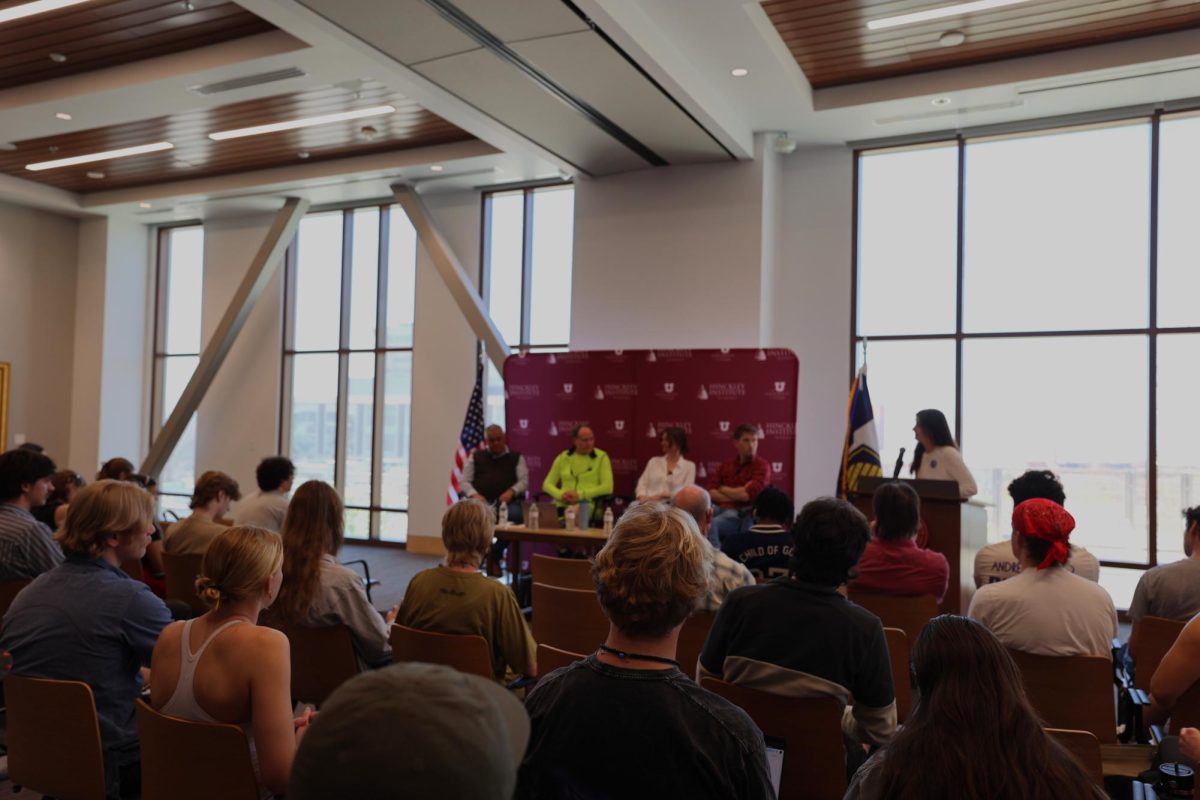
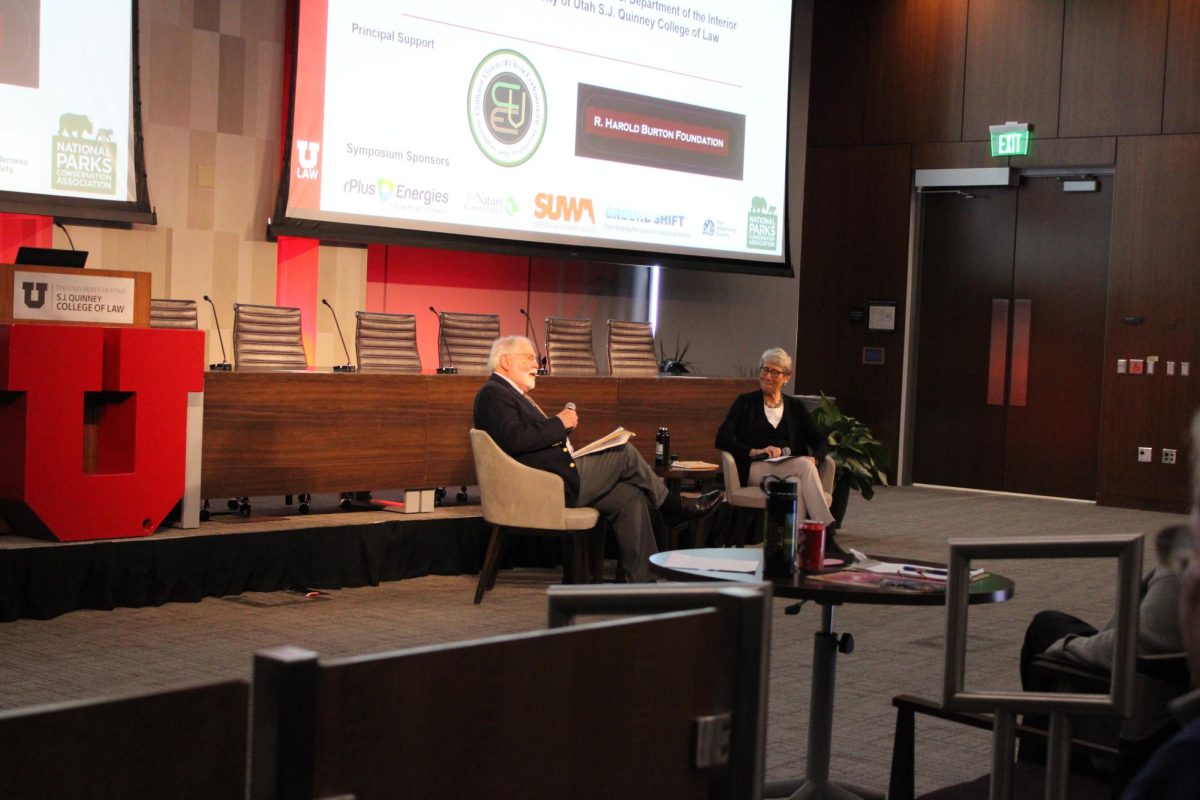
The SJ Quinney School of Law hosted its annual Wallace Stegner Symposium March 19-20. Top environmental figures addressed environmental concerns and preservation of public lands.
The symposium primarily focused on land preservation in the American West, with appearances from former Secretary of the U.S. Department of the Interior Sally Jewell and Ryan Gellert, current CEO of Patagonia. Dean Elizabeth Kronk Warner and professor Lincoln Davies kicked off the event on Thursday, focusing on changing economic policies in the American West.
Day One: Changing land policy, mining and public land preservation
The symposium’s first day primarily focused on changing public land policy within the United States as a whole, with a specific emphasis on land policy in the western United States.
John Leshy, a law professor at University of California San Francisco, addressed broad nationwide concerns, citing wealth inequality and court rulings as barriers to public land protection. “It’s not going to change for many years, maybe decades.” he said. However, Leshy stated there is a possibility for change despite these trends. “On the other hand, is it possible that public lands politics might be uncoupled from somewhat broader trends,” he added.
Leshy pointed to the sweeping bipartisan pushback to Senator Mike Lee’s (R-UT) proposal to sell millions of acres of Bureau of Land Management (BLM) lands as a sign these trends may be changing. “He proposed it, and there was an instant, widespread, almost across the board, reaction of hostility.” He said politicians who reacted negatively “included a number of Republican politicians as well as Democrats, showing that there is a broad base [of] bipartisan support” for public lands preservation.
Harvard Law School professor Andrew Mergen echoed this statement. “I had this in my family, where my parents were from public land states, Nevada and Utah, and there wasn’t any sort of uniformity about political beliefs, but [just] that public lands were important.”
Mergen also argued that this bipartisan pressure should urge the United States Congress to take action. “Can’t we agree, knowing that there’s bipartisan support for public lands, that this is a good time for Congress to take a good look at this issue?”
Day Two: Forest health, policy insight and future of public lands
The second day of the symposium opened with a discussion on strategies to mitigate forest fire severity. Speaker Jonathan Wood from the Property and Environment Research Center argued restoration work through intentional thinning and controlled fires is “an urgent need.”
“It is a huge problem that we have to tackle, and we are currently not doing anything close to the scale required,” he said.
According to Wood, the National Forest Service estimates that about 80 million acres of national forest land are in need of restoration. “We’re also seeing the effects of climate change and wildfire crisis on top of that,” he said. Wood argued for more transparent policies allowing these controlled burns and forest thinning to take place. “We cannot do forest restoration at the scale required without significant permitting reform,” he said.
The next speaker, Sally Jewell, the former CEO of REI and former Secretary of the U.S. Department of the Interior, primarily discussed her experience in both roles, as well as long-term government impact on public lands. “The decisions we make in the Department of the Interior are not just for now. They’re not just for us in this generation. The decisions we make are going to impact people for hundreds of years to come,” she said.
Patagonia CEO Ryan Gellert echoed Jewell’s statement. “We do the work we do because it’s important work,” he said. “It’s the right work to do and we didn’t start it as a result of outside pressure and we didn’t stop it as a result of outside pressure.”
Elle Howell contributed to reporting this story.