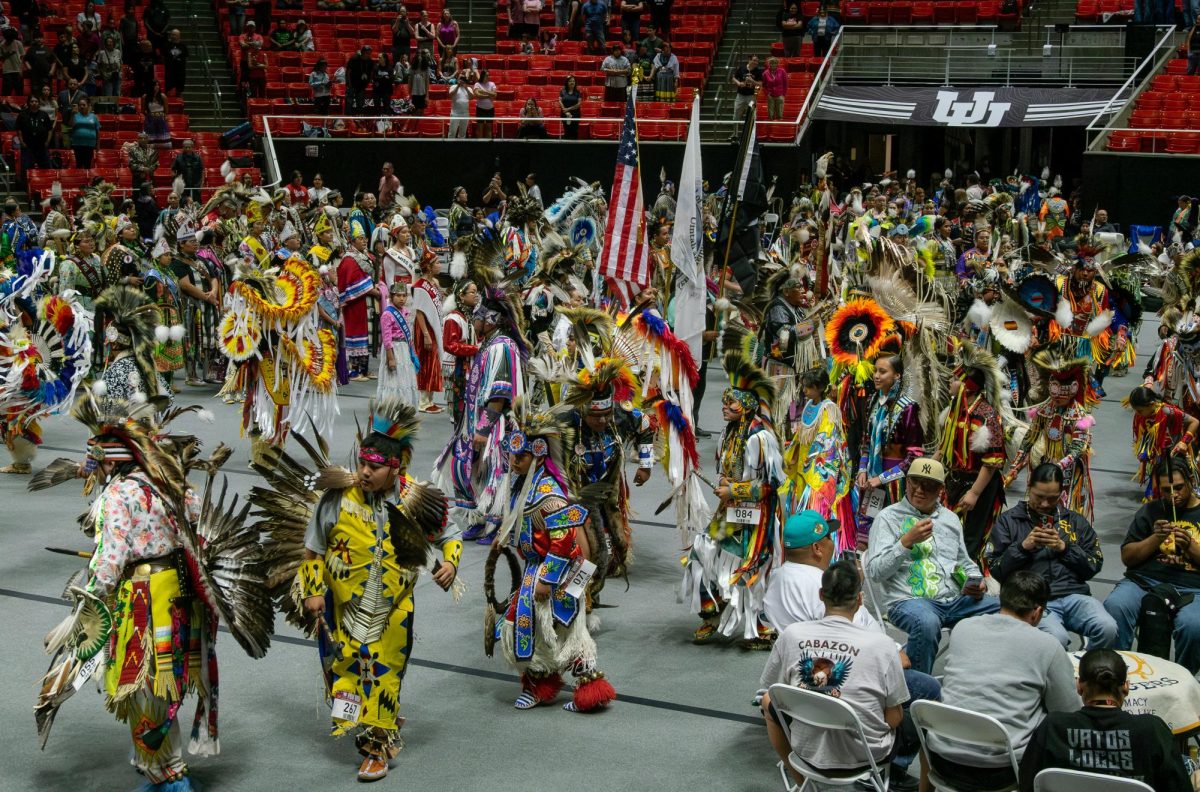
The University of Utah hosted its 54th annual Pow Wow on March 21 in the Jon M. Huntsman Center. Over 200 dancers and seven drum groups performed throughout the day, and the event attracted over 1000 attendees. Community members said it is an opportunity to celebrate their culture, preserve their traditions and connect tribes.
“This is our third year at the Huntsman Center,” explained Center for Native Excellence and Tribal Engagement Director Samantha Eldrige, one of the event’s main organizers. “We used to be in the Union Ballroom, but we’ve outgrown the space. We really wanted to accommodate more people and really create that welcoming space for everyone.”
The dances’ importance
Eldrige explained how this year’s Pow Wow, titled “Threading our Legacies,” is important. “It’s not only to provide a space for awareness, celebration and education,” she said, “but really to provide an opportunity for our students who may come from tribal and rural areas, who may not be able to practice some of their cultural traditions or may be feeling homesick… It’s really just a chance for our students to come together to create that belonging space, that cultural affirmation and provide that home away from home.”
Nima Groves, a Hopi and Northern Ute jingle dress dancer and incoming freshman at the University of Utah, echoed that sentiment. “For me, Pow Wows are like a breath of fresh air… they’re a great opportunity to reset,” she said. “It’s a social gathering, but there are some spiritual moments throughout. Those moments, for me, are super special because it’s an opportunity for me to realign… Dancing has been my main connection to my culture.”
Students played an important role in planning and organizing this event through on-campus hubs like the Student Affairs Center for Native Excellence and Tribal Engagement and the student-led Inter-Tribal Student Association. But participation from the broader community is crucial to the University of Utah’s yearly Pow Wow. Hundreds of families and individuals of all ages, from experienced elders to up-and-coming youth, came from all across the Intermountain West, squeezing into bleachers and stairs for this important opportunity to connect and share their cultures. Many attendees spoke excitedly about getting to see friends and relatives, and the responsibility to pass their traditions along.

Sharing the culture across generations
The rising generation was an important focus. Organized into two Grand Entries, the day’s proceedings included several categories for children and teenagers, including the Tiny Tots, for young dancers. Margaret, who danced in the combined 65+ Golden Age dance and has been attending this Pow Wow for all 54 years, spoke about the importance of involving the youth.
“The reason we have Pow Wows is to get together. We come here to show our children and grandchildren … They have to experience it for themselves. We share stuff with people to let them know your tribe’s traditions, and then they [our children] see that,” she said.
Shelby Chapoose, who tracked points for the contest, said the dances keep people, especially the youth, close to their cultural practices. She said it brings a “sense of fulfillment” to participate and connect with family from everywhere.
Chapoose said the Pow Wow is a friendly competition. “It’s a way to get out and show… our different dance styles, show what region we’re from… and come together in celebration,” she said.
Sheila Greymountain is Diné and from Colorado. Her nephew was called to dance as headman in the day’s final grand entry, and she said Pow Wows get families together to celebrate culture. “It’s an honor to be called to be able to do dances like this,” Greymountain said.
Her daughter, Faith Greymountain, said Pow Wows can also bring awareness to some of the issues Indigenous people face, like substance abuse and mental health disorders.
An outreach manager for Sacred Circle Healthcare, Derek Goudie, attended the event. Sacred Circle provides tribal members with several types of care, including dental and behavioral. Goudie said Pow Wows contribute to “tribal longevity,” one of Sacred Circle’s core values. “[Pow Wows] sustain this culture for future generations,” Derek said, “through telling stories, through song and dance.”
Indigenous presence at the U
Sienna Riggs is the American Indian Ambassador to the U. She grew up in Tuba City, on the Navajo Nation in Arizona. Now, she’s a freshman studying chemistry. “I’m representing the native community within our university and spreading cultural awareness,” she said.
For Riggs, attending this Pow Wow was a way to give support to other Indigenous people and tribes. “Events like these show how strong we are as a community… [and] show all the meanings behind the different dances,” she said.
Riggs is promoting education for the youth living on reservations and challenging the stigma against leaving those reservations. “You can seek outwards to get more information and bring it back to your home people,” she said.
That being said, for young people who grew up on reservations, leaving them to attend college can be a difficult prospect. Kailah, a Diné junior at the University of Utah who has volunteered at previous Pow Wows, spoke about how organizations like the Inter-Tribal Association and events like the Pow Wow help overcome the cultural disconnect some Indigenous students experience, describing them as “healing.”
While an important gathering space for Indigenous people, participants stressed the open nature of pow wows. For interested people of all backgrounds looking for respectful ways to support, simply showing up is a great way to start. Many pow wows are free, and vendors selling a variety of goods are often present. As Kailah invites, “You should befriend Native Americans, and go to our events!”