
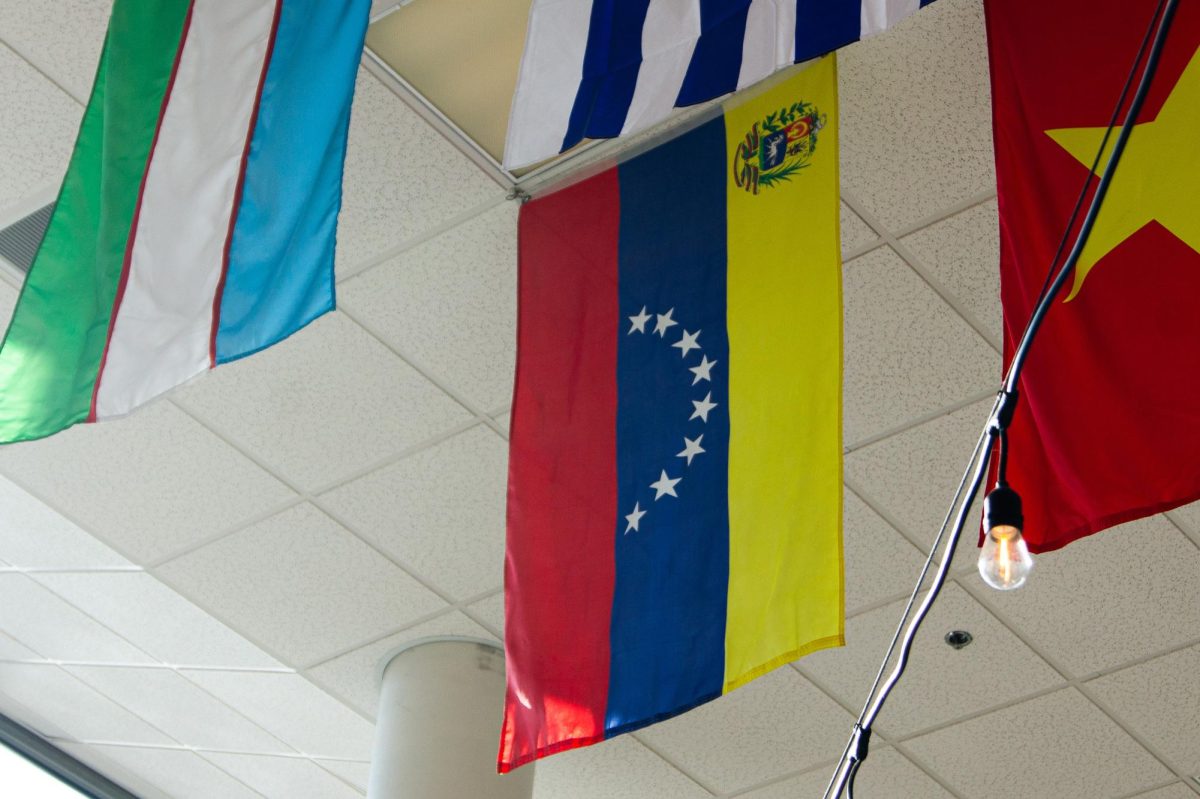
On Jan. 3, the United States military launched an operation to remove Venezuelan President Nicolás Maduro from power. The following day, protesters gathered in downtown Salt Lake City, condemning the Trump Administration’s actions in the country.
Reactions across Utah, however, have varied, particularly within the state’s Latino communities. Utah is home to a large Venezuelan population, with Venezuelans now representing the second-largest Latino subgroup in the state.
History of US intervention
Throughout the Cold War, the United States intervened against many regimes that threatened US interests. Rohan Chatterjee, a professor and historian of modern Latin America at the University of Utah, explained that the pattern started long before the operation in 2026. “This fear of communism emerging in the quote unquote backyard drove U.S. policies to both have direct and indirect interventions in the region, much more indirect … in the Cold War,” Chatterjee said.
However, Chaterjee added that the intervention may have been driven by more than just ideological disagreement with the Venezuelan government. In 2025, the Department of War issued its 2025 National Security Strategy, which lists the maintenance of the United States’ “unrivaled ‘soft power'” as one of the year’s major goals.
“[The Trump Administration] want[s] to re-establish U.S. supremacy in the Western Hemisphere,” Chatterjee said. “They see the involvement of China, they’ll claim Iran, other so-called adversaries being present in the Western Hemisphere. They think that’s intolerable and so there’s a push to return to a sort of much more focused foreign policy on the Western Hemisphere and particularly sort of pushing out other actors that are deemed hostile or adversarial to strengthen U.S. control,” he predicted.

Student reactions
Responses from publics and governments around the world have varied between hope and fear for a future without Maduro. Similarly, government reactions have been mixed — particularly in Latin America — with Brazilian president Luiz Inácio Lula da Silva, Colombian president Gustavo Petro as well as the governments of Mexico and Chile condemning the strike, while the governments of Argentina, El Salvador and Ecuador supported the operation.
A Venezuelan student spoke to The Chronicle about his experience, describing his initial reaction watching the events as “uncertain,” since much of his family lives in Caracas. “It was very confusing and I was very worried about my family,” he said. “Everything started at 2 A.M. in the morning there, and we didn’t know what was going on for the next three or four hours.”
He described a feeling of hopelessness. “The thing is, for several hours, there was this uncertainty in the air. No one knew what was really going to happen, what’s the next step,” he added. “It was just the expectation and the feeling of there’s nothing I can do. There’s nothing anyone there can do. So I guess we’ll just have to sit and watch.”
The student requested to remain anonymous due to fear of retaliation.
U student Marcos Van Dalen, the Miami-raised child of two Venezuelan immigrants who moved to the US for education in the 1980s, said he was surprised that the administration had intervened in such a way. “I remember going to bed to big headlines about strikes happening … I text my dad and he’s like, ‘thank God.’ Super happy. I have yet to meet a Venezuelan that’s not extremely happy about [the operation],” Van Dalen said.
Regime change and elections
Van Dalen explained that his family views figures like opposition leader Maria Corina Machado favorably, but that there were concerns about whether she could realistically take power. “I remember not just my parents but a lot of people looking to those political leaders as a hope for change, but that was all snuffed out the moment each election was repeatedly stolen,” he said. “When I asked [my mother about the current events], she was not surprised about it because the government is completely corrupt at all levels, and her idea was that it is going to take years for meaningful change.”
The anonymous student said that he felt “betrayal” when Trump said he would lead Venezuela.
“Right at that moment, I felt a little betrayal because obviously, there were some presidential elections back in 2024 and a candidate was elected by the Venezuelan people,” he said. “We definitely thought that the path once Maduro was taken was to just put the person that we actually elected [into office]. Not having that response from the U.S. government after the intervention was a little shocking,” he said.
The future of Venezuelan relations
On Jan. 3, Trump hosted a press conference announcing the operation, in which he said the United States would “run” Venezuela for the time-being. Trump also stated that they would “fix the badly broken infrastructure, the oil infrastructure and start making money for the country.”
Upon hearing Trump’s remarks, Van Dalen said he was “curious” about how his plans for Venezuela would play out. He explained that he understood that the United States wanted to control oil exports from Venezuela, which account for 90% of the country’s export revenues. “I mean, I think that’s a good way of leveraging a government and forcing it to do something. ‘You’re not going to cheat at elections’ or whatever it is, right? ‘You’re going to be open to U.S. investment,’ without having to send a bunch of marines in or a bunch of soldiers in,” he said.
The student said he is concerned that the US is too preoccupied with economic investment in Venezuela that they are failing to focus on the release of political prisoners. “There’s still a ton of people in jail but they need to release them, and I think that it’s supposed to be a priority over oil or anything else,” he said. “I mean, what matters most is human life.”
Marcos Van Dalen | Feb 3, 2026 at 3:21 pm
Great article James, thank you for the well rounded perspective!
Fernanda | Feb 1, 2026 at 12:49 am
This is an amazing article James! Thank for sharing wonderful insights!