
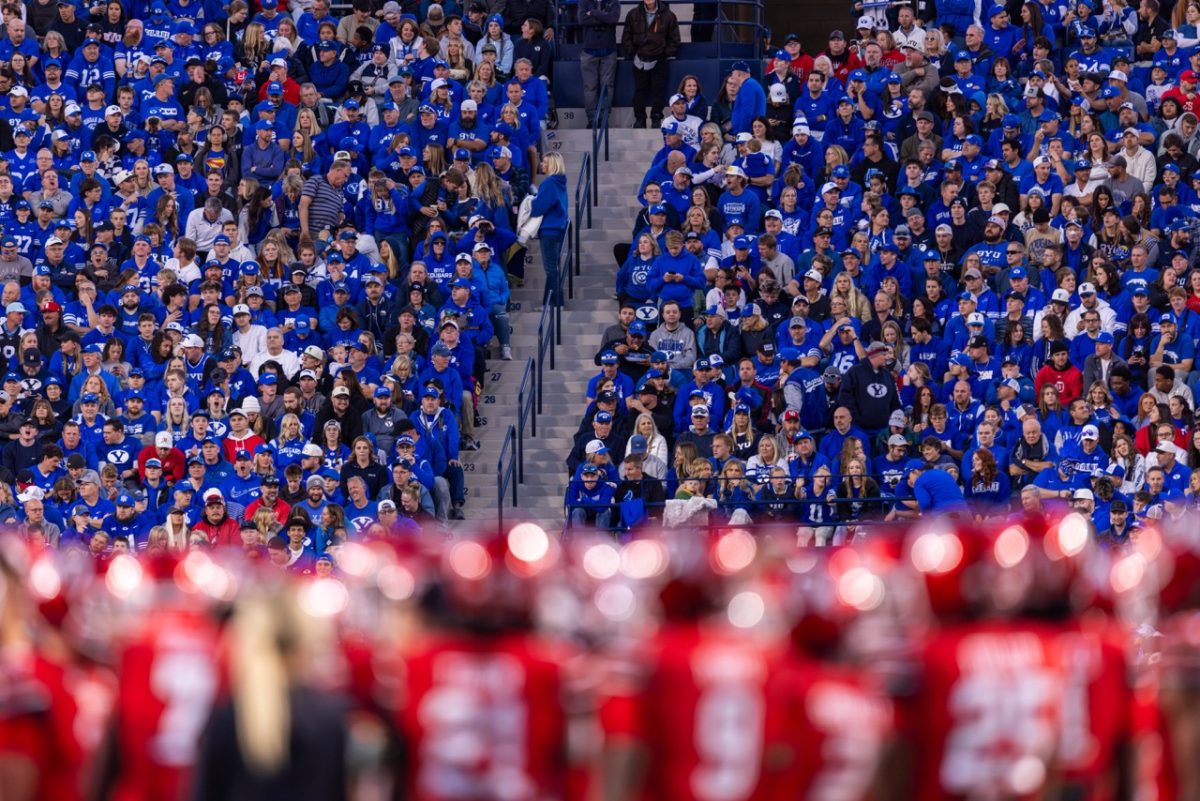
In 1895, the University of Utah football team beat Brigham Young University 12-4 in the schools’ first game meeting.
“When Brigham Young came into the valley, he pointed to where the University of Utah would be and said, ‘This is the place.’ Provo was just an afterthought,” said former head coach Ron McBride, in a statement on the location of BYU.
For over a century, the Holy War — the rivalry between the U and BYU — has been one of the most intense matchups in college football.
This year, the Athletic ranked the Holy War rivalry 28 out of the top 100 college football rivalries. The two teams have played 97 recognized games against each other. “Only 40 miles separate the campuses and their mutual upward trajectory has elevated it into a major power-conference series. Its profile has grown over the past two decades and it could become even more impactful with both in the Big 12,” said the Athletic.
Religion and proximity
There are several theories about how the rivalry between the two teams became so intense. One commonly cited factor is religion, reflected in the name “Holy War.”
BYU is owned by the Church of Jesus Christ of Latter-day Saints. The U has a long history of LDS influence and a substantial LDS student population, though the schools differ in how religion is integrated into campus life. “The Holy War in some respects has become a proxy for feelings about the LDS church,” said Fred Esplin, former university administrator and longtime follower of Utah football.
Proximity is another factor. The universities are about 40 miles apart, roughly an hour’s drive. According to Esplin, that distance shapes interactions among fans, friends and family members who live within the same region.
Conference shifts
From the time that BYU football program officially started in 1922 until 2010, the teams both played in the Western Athletic Conference. After Utah moved to the Pac-12 Conference in 2011, the schools agreed to play an annual rivalry game. Last year, Utah joined the Big 12, meeting BYU in a conference game after BYU’s move to the Big 12 in 2023.
Utah has won against BYU 52 times, lost 31 times and tied four times. “There have been years where the University of Utah has been dominant and there have been times in the war where BYU has been dominant. It’s ebbed and flowed over the years,” said Esplin.
Fan base
The fan bases for both teams have historically been deeply invested in the rivalry. In 1999, tensions escalated when a Utah cheerleader and a BYU fan got into a fist fight. Utah was winning the game when the cheerleader, William Priddis, ran across the visitor sideline with a large U flag.
BYU fan, Brandon Perry, was so upset with the score of the game and the “taunting” from Priddis that he jumped down from the stands and tackled the cheerleader. An investigation from BYU Police followed the incident to see if Priddis had crossed the line in his actions and neither party faced charges.
Last year, the schools partnered on a campaign aimed at reducing some of the animosity that had developed in recent years. Called “Rival Right,” the initiative is a joint effort to encourage positive fan conduct at both institutions.
However, strong feelings still remain part of the matchup. “BYU and Utah bring out the worst in each other,” said Greg Kindon, a 1988 Utah graduate.
This year, the U’s campus made sure to not take any chances during the rival week by crossing out every letter “y” that could be seen. “We’re seeing an intensity play out in a way that it used to and it’s fun to watch the team go back to those super competitive roots that all Utahns know and love,” Esplin said.